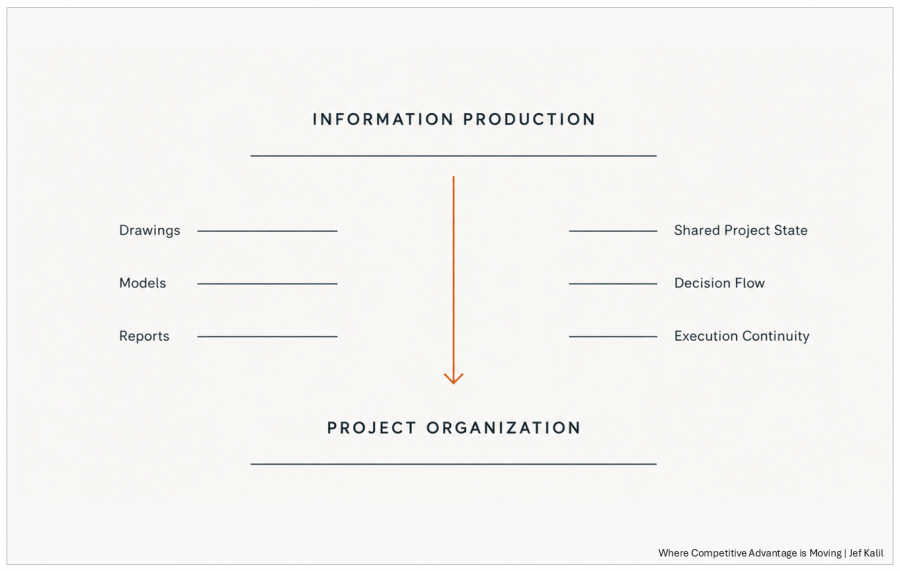
The revised package was received by procurement while site planning continued using the previous release..
Both teams had current information within their own area of work. Design had completed its update. Procurement had begun reviewing the revised scope. The site team was preparing the next sequence against the information that had already been released.
Each team was progressing, but the project was not yet operating from the same current state.
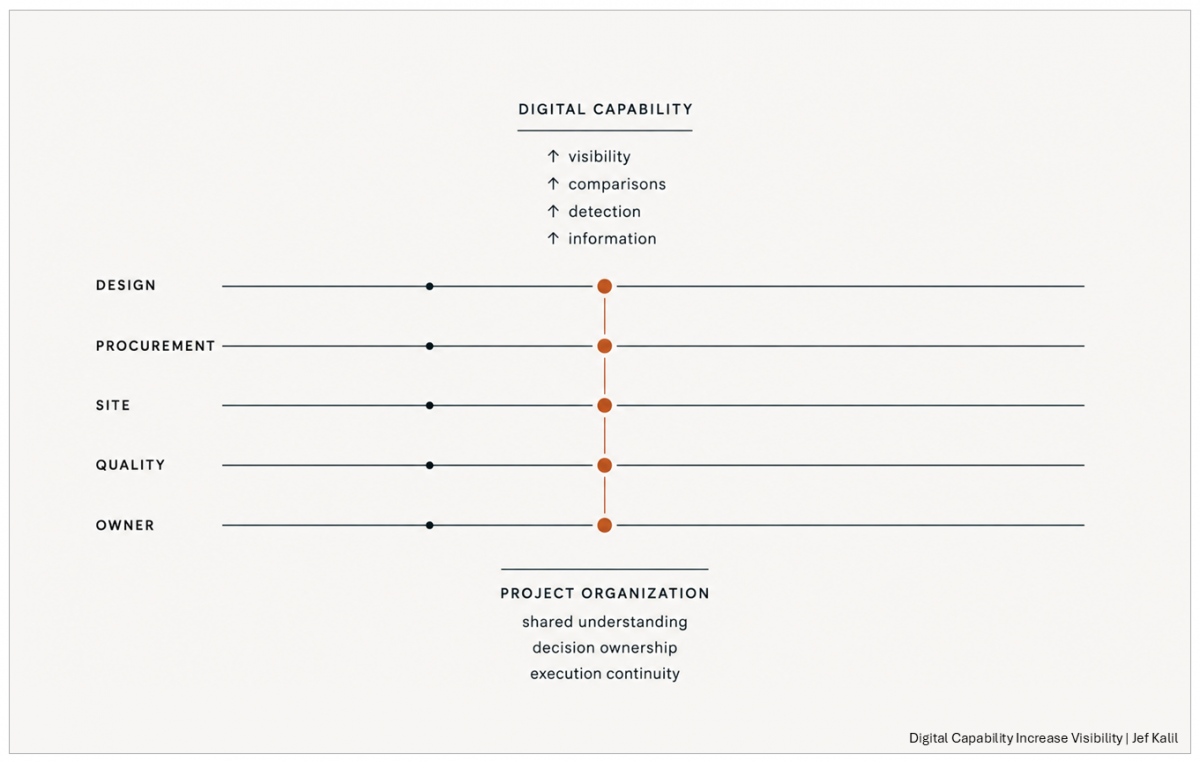
Digital capability is making conditions like this easier to identify. More project information can now be created, compared, distributed, and reviewed with less manual effort. Models can be checked more frequently. Progress can be captured continuously. Documents can be classified and searched. And changes can be surfaced before someone manually compares two releases.
The direction is broader than construction.
In its 2026 report, Agents, Robots, and Us: How AI Reshapes Work and Skills in Europe, the McKinsey Global Institute estimates that 58 percent of current work hours across ten European economies could theoretically be automated using existing technologies. For Germany, the estimate is 59 percent.
McKinsey is careful to distinguish technical potential from actual adoption. The report does not suggest that 59 percent of jobs will disappear. Its argument is that activities within jobs will increasingly be distributed between people, software-based agents, and physical machines. That distinction matters for construction and the AECO industry.
Projects consist of thousands of connected activities distributed across temporary organizations. Designers produce and revise information, consultants validate specialist requirements, and owners make scope and risk decisions. So that contractors can plan work, procurement can convert coordinated information into orders, and site teams can respond to actual conditions.
Digital systems can increasingly support parts of each activity. They can identify changes, compare documents, summarize discussions, detect incomplete information, classify observations, analyze progress, and flag emerging risks.
This increases the project’s ability to understand its current state, but it does not automatically create a shared understanding of what should happen next.
A system may identify that a detail changed after procurement began. It might show that an issue remains open while installation approaches. Or, it may detect that two or more teams are working from different revisions.
But it’s the project that needs to determine whether procurement pauses, whether the package owner accepts the remaining risk, whether the site sequence changes, and who communicates the decision across the delivery chain.
Those are project-organization decisions.
Human capability is not disappearing
One of the most relevant findings in the McKinsey report is that most human skills are expected to endure, even when some of the work associated with them becomes automatable.
For Germany, McKinsey estimates that 86 percent of human skills will remain relevant. For the UK it is just as high. The report also identifies increasing employer demand for capabilities including quality assurance, critical thinking, process improvement, people management, regulation, and compliance.
They are the capabilities that keep digital work coherent, rather than edge-case capabilities around construction delivery.
- Planning will still matter, but more of the underlying information may be prepared automatically.
- Quality control will still matter, but systems may detect more potential deviations before a person reviews them.
- Problem-solving will still matter, but teams may begin with a much richer picture of the project condition.
- Leadership will still matter because someone must decide what the information means for scope, risk, sequencing, cost, and execution.
The opportunity is therefore not simply to automate more project activities, but to organize delivery so that automated and human contributions remain connected to the same current project state.
What this changes for Digital Project Delivery
A digital model is no longer valuable only because it contains coordinated geometry. Its value also depends on whether its information is current for the decision being made.
The value of a Common Data Environment (CDE) no longer comes only from giving teams access to documents. It depends on whether packages, issues, decisions, approvals, and context remain connected as work progresses.
The value of an issue workflow no longer comes only from creating visibility. It depends on whether ownership remains clear and closure occurs before downstream teams act.
The more project information can be produced and reviewed digitally, the more important these coordination conditions become. Without them, projects may move faster while becoming less coherent.
As design releases more frequently, procurement processes more information, site teams capture more observations, and dashboards report more exceptions, projects inevitably move faster. If decision paths do not keep pace, teams begin compensating locally.
Procurement works from the latest package it has formally received, site planning continues from the last approved sequence, a consultant resolves an issue through a direct call, and coordinator maintains a separate tracker because the shared structure no longer reflects what is happening quickly enough. This means that each local response may be reasonable, but together, they create multiple versions of the project.
The opportunity is continuity
McKinsey estimates that automation could create approximately $28 billion in economic value within Germany’s construction sector by 2030 under its midpoint adoption scenario.
The report associates that opportunity with several areas, including core operations, back-office work, product development, procurement, and supply-chain activity. This suggests that digital capability will not sit within one specialist function. It will increasingly affect the full sequence through which projects are planned, coordinated, procured, delivered, and handed over.
That makes continuity more important which means:
- A change identified during design needs to remain connected as the package enters procurement.
- A procurement decision needs to remain visible when the site sequence is updated.
- A site observation needs to reach the party that owns the next decision.
- An accepted deviation needs to become part of the current project state rather than remaining inside a meeting note or private conversation.
This is where the future of Digital Project Delivery becomes more about organizing execution, and less about producing information.
- For owner organizations, this means defining how digital findings enter governance and risk decisions.
- For contractors, it means keeping design, procurement, trade planning, and site execution connected to the same assumptions.
- For PMOs, it means moving beyond reporting toward maintaining decision and issue continuity.
- For BIM and CDE consultancies, it means treating digital structures as coordination infrastructure rather than technical environments.
- For Lean and integrated delivery teams, it means connecting faster information flows to reliable commitments and clear decision timing.
The industry is making steady progress toward a more visible and connected project environment. Digital capability is making a continuously updated shared project state increasingly possible across design and delivery.
The opportunity now is to maintain that continuity as work moves forward, so that digital systems can show what changed while project organization determines whether the right teams understand it, own it, and act before delivery moves on.
About the Author
Jeffrey Albert Kalil writes about digital project delivery, project organization, and the coordination structures that keep AECO projects aligned from planning through execution.
About this Series
This article is part of an ongoing series exploring how digital project delivery creates value through project organization, shared project state, decision flow, information flow, and execution continuity across the building lifecycle.
Future articles explore these ideas through observable project situations before revealing the coordination mechanisms that shape execution.
Reference
McKinsey Global Institute, Agents, Robots, and Us: How AI Reshapes Work and Skills in Europe — Germany Country Dashboard, May 2026: https://www.mckinsey.com/~/media/mckinsey/mckinsey%20global%20institute/our%20research/Agents%20robots%20and%20us%20How%20AI%20reshapes%20work%20and%20skills%20in%20Europe/Agents-robots-and-us-How-AI-reshapes-work-and-skills-in-Europe_Germany.pdf