Digital capability is giving project teams an increasingly detailed view of what is happening across the built environment.
Reality capture can document existing conditions with increasing speed and precision. BIM and GIS can connect information that previously sat in separate environments. Digital twins can add operational context, while AI can help teams compare, interpret and surface patterns across growing volumes of project information.
My visit to INTERGEO in Munich reinforced how far these capabilities have progressed, and how the conversation is shifting beyond data capture as value in itself.
That is significant progress for AECO. It also changes what becomes important next.
As the industry becomes better at seeing project reality, the delivery challenge becomes ensuring that decisions, ownership and execution remain aligned with that reality.
From visibility to project state
We understand increasingly well how a newly captured digital condition can be accurate, how a model can be current and how a project change can be detected quickly.
That does not mean the project itself is operating from the same current state.
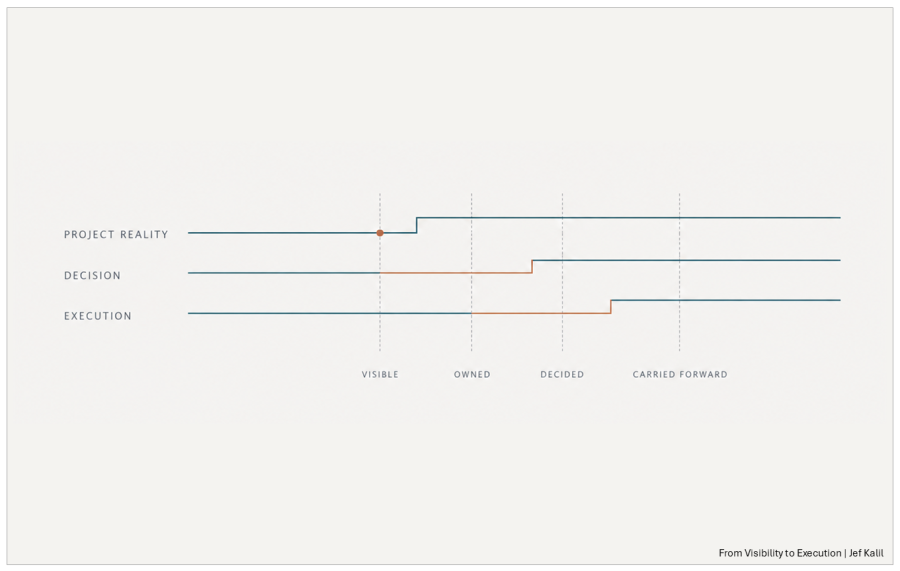
Consider a changed site condition identified during field verification.
The new information may be available immediately, but design may still need to understand its impact on a connected interface. Procurement may already be working from an earlier assumption. A package owner may need to decide whether the change affects release. The site team may be preparing an installation based on information that was correct when it was issued.
The digital information is current, but the project state is not yet current.
Closing that gap requires more than moving information between systems.
The changed condition needs context. Its impact on upstream and downstream work needs to be understood. Someone needs to own the next step so that an actionable decision can be made, and that outcome needs to reach every team whose work depends on it.
Only then has visibility changed execution.
Trust is part of the coordination chain
Another recurring theme at INTERGEO was the importance of trust, original source and context.
As more project information comes from connected sources, teams increasingly need to understand not only what the information says, but where it came from, when it was created and whether it is appropriate for the decision being made.
This becomes particularly important as automated interpretation becomes more common.
A detected discrepancy may be useful. A summarized issue may save time. A comparison between datasets may expose a change earlier than manual review. But before any of those findings change the work, the project still needs to establish what they mean for execution.
Is the evidence current enough to change a package? Does the finding require field verification? Who owns the consequence? Can procurement continue? Does an installation sequence need to change?
These questions sit between digital capability and project organization.
Traceability and source context help teams understand what they can rely on. Ownership, verification and decision structures determine what the project does next.
Faster visibility changes the coordination requirement
Better digital capability shortens the distance between something changing and the project becoming aware of it.
That creates real value. It also puts more pressure on the coordination structures behind delivery.
A changed condition that once took days to surface may now be visible almost immediately. But if the decision path still takes the same amount of time, the project has not become equally faster at responding.
Work continues in the meantime.
A consultant may resolve part of the issue directly with another discipline. Procurement may continue from the latest formally released package. The site team may plan from the last approved sequence. A coordinator may maintain a separate tracker because the shared structure has not caught up with what is happening.
Each response can make sense locally. Across the project, however, teams begin working from different versions of the same reality.
The more quickly a project can see a change, the more important it becomes that ownership, decision paths and information flow can keep pace with it.
The objective is not simply to connect more information. It is to maintain continuity between what the project knows, what it has decided and what teams are doing.
The opportunity for Digital Project Delivery
This is where I see the emphasis of Digital Project Delivery continuing to evolve.
Digital capability is making a shared current project state increasingly possible.
Models, field conditions, issues, decisions and progress can be connected more closely than before. Changes can become visible earlier, and information can move across organizational boundaries faster.
The opportunity is maintaining that continuity through delivery.
Whether viewed from an owner, contractor, PMO, project controls, BIM/CDE or integrated delivery perspective, the underlying requirement is similar: new information needs to enter the project’s decision and ownership structures quickly enough to influence the work that depends on it.
That means connecting what becomes visible to issue ownership, decisions, release, sequencing and downstream consequences rather than stopping at reporting or information availability.
None of this reduces the value of better digital capability. It increases it.
The industry is becoming better at capturing project reality, connecting information and identifying change earlier. That gives project teams an opportunity to respond earlier as well.
But what matters for delivery is what happens between seeing a change and changing execution.
Can the change be understood in context? Is the next step owned? Can the required decision be made in time? Does that decision reach every team whose work depends on it? And does the shared project state change with it?
That is where information flow, decision ownership and coordination structures meet.
And it is where digital capability becomes delivery capability.
About the Author
Jeffrey Albert Kalil writes about digital project delivery, project organization and execution continuity across the AECO industry. His articles explore how decisions, ownership and information move through projects—and why those coordination structures increasingly determine delivery performance.
About this Series
This article is part of an ongoing series exploring how digital project delivery creates value through project organization, shared project state, decision flow, information flow and execution continuity across the building lifecycle.